


Studio Master Studies: Impressionism (Monet)

Impressionism started in France in the late 1800s as artists began to break away from traditional, highly detailed painting. Instead of carefully controlled studio scenes, they went outside to paint directly from life, trying to capture light, atmosphere, and fleeting moments. The focus wasn’t on perfect detail, but on the feeling of a scene—how it looks in a specific instant, like a sunrise, a windy cliff, or a garden in bloom. Brushstrokes became looser and more visible, and colours were often placed side by side to let the eye blend them.
One of the most important Impressionist artists was Claude Monet. Over his career, you can actually see how his way of painting evolves—from early city and coastal scenes to immersive gardens and almost abstract studies of light and reflection.
Earlier this year, I decided to do a series of Master Study paintings in watercolour and gouache. The first artist I selected to study was Claude Monet. Here are the paintings I selected along with photos of the finished small 6x8" paintings. These paintings will be available to purchase in our gallery soon. I'm in the process of framing them, but they could be ready for the last weekend in May.
Impression, Sunrise (1872)
Impression, Sunrise is the painting that basically gave Impressionism its name. It shows the harbour at Le Havre at sunrise, with a glowing orange sun cutting through misty blues and greys. Boats sit quietly in the foreground, while ships and cranes fade into the fog in the background.

What stands out is how loose everything feels. The brushwork is quick and sketchy, and there’s very little fine detail. At the time, critics didn’t really know what to make of it—they thought it looked unfinished. But that “unfinished” look is exactly the point: Monet is capturing a quick moment of light and atmosphere, not a polished, permanent view.
The Cliff Walk at Pourville (1882)
In The Cliff Walk at Pourville, Monet shifts fully into coastal landscape painting. Two women walk along a grassy cliff above the sea in Normandy, but the real focus is the environment around them—wind, sky, and water.
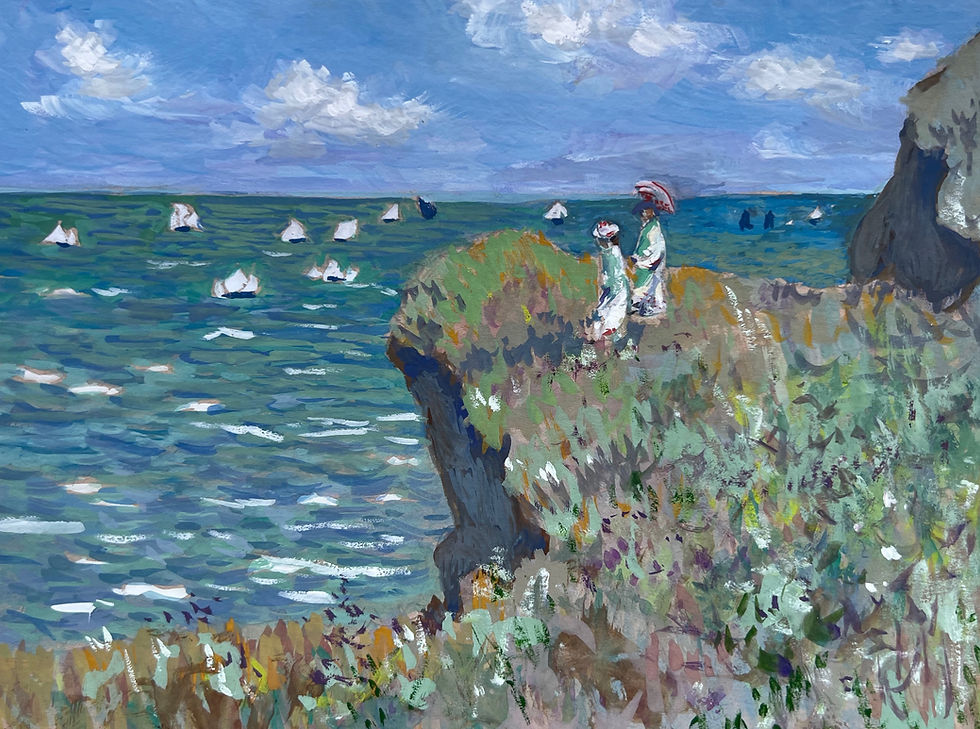
The brushwork becomes more energetic here. Grass, clouds, and waves are built from loose, broken strokes that make everything feel like it’s moving. The composition also opens up, pulling your eye across the cliff edge toward the sea. It feels like a snapshot of a real moment outdoors rather than a carefully staged scene.
The Cliff and the Porte d’Aval (1880s)
With works like The Cliff and the Porte d'Aval, Monet explores the dramatic cliffs of Étretat. The natural rock arch becomes a strong visual anchor, framing the sea beyond it.

Instead of crisp outlines, Monet builds the cliffs from soft, broken brushstrokes. The light bouncing off the chalk cliffs is just as important as the shape itself. The sea is layered and restless, and the whole scene feels like it’s constantly shifting. It’s less about a fixed view and more about how the landscape changes with light and weather.
Tulip Fields with Rijnsburg Windmill
In Tulip Fields with the Rijnsburg Windmill, painted during Monet’s time in the Netherlands, the focus turns to wide, flat fields filled with rows of bright tulips. A windmill sits in the distance, anchoring the scene.

The repeating rows of flowers create a strong rhythm across the canvas, almost like a pattern. Colour becomes more intense here—reds, yellows, and purples sit next to greens in bold contrast. Compared to his coastal paintings, this feels more structured in layout but still loose in brushwork, with Monet clearly interested in how colour fields shape the whole landscape.
The Artist’s Garden at Giverny (1900)
By 1900, in The Artist’s Garden at Giverny, Monet is painting his own garden. This isn’t just a landscape anymore—it’s a space he designed and lived in. A path runs through dense flower beds bursting with colour.

The brushwork gets even looser, and individual flowers start blending together into patches of colour and texture. Light filters through the garden, softening everything. Instead of focusing on specific plants, Monet is more interested in the overall feeling of being surrounded by colour and nature.
Water Lilies (1914–1916)
In his later years, Monet paints the famous Water Lilies (Nymphéas) series. These works come from his pond at Giverny and often don’t even show a horizon line.

Instead, you get floating lilies, reflections, and shifting patches of light and colour. The surface of the water becomes the entire world of the painting. The brushwork is incredibly free and abstract, almost dissolving objects altogether. These works feel calm, immersive, and deeply focused on perception itself.
Looking across Monet’s work, you can really see a progression. He starts with recognizable outdoor scenes like harbours and cliffs, and slowly moves toward gardens, water surfaces, and eventually almost abstract fields of colour. But the core idea stays the same: it’s never just about what something is—it’s about how it looks in a specific moment of light and atmosphere.

Comments